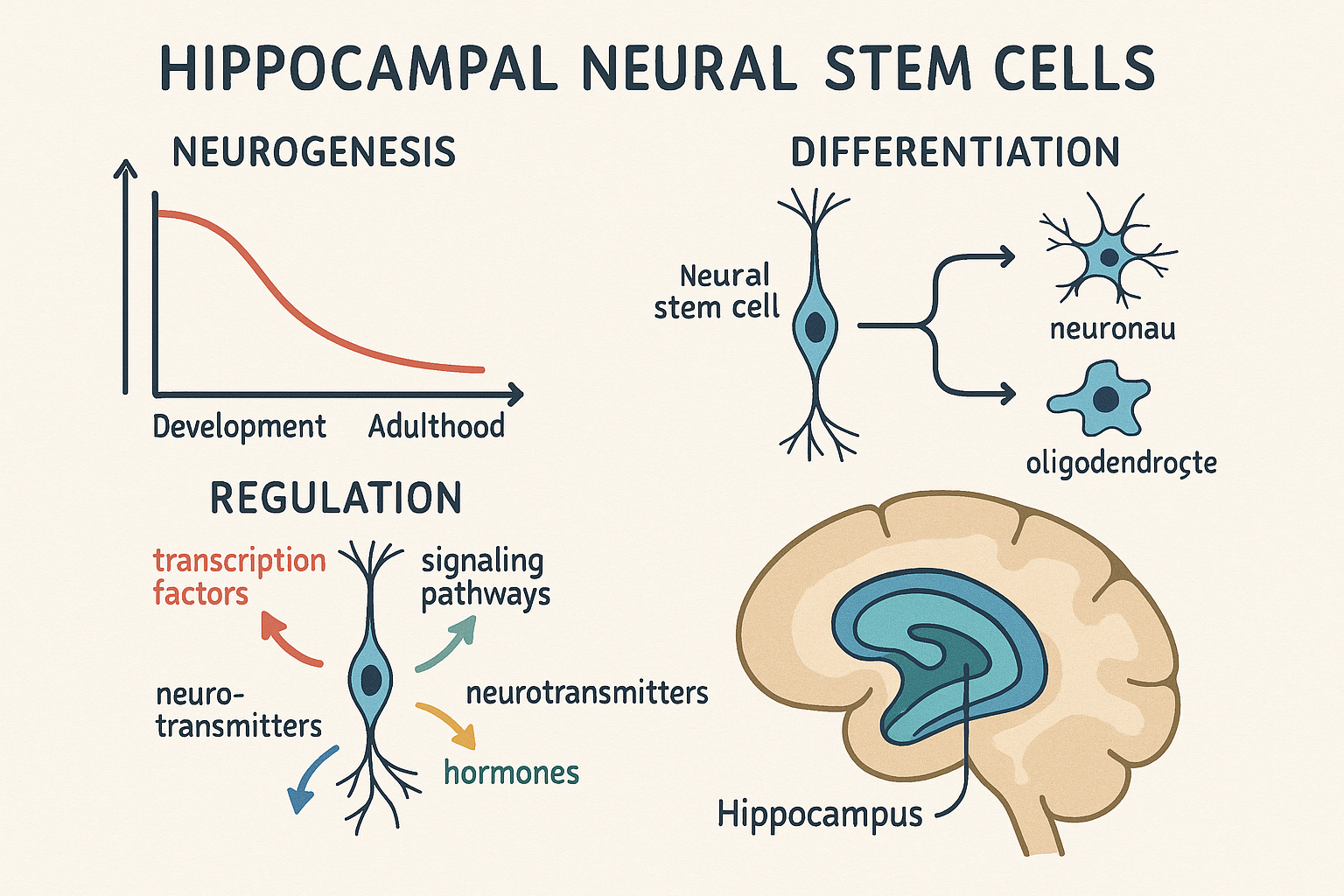
Hippocampal Neural Stem Cells (hNSCs) are a specialized population of multipotent, self-renewing progenitor cells located within the dentate gyrus of the hippocampus. They are central to adult neurogenesis, memory formation, learning, and brain plasticity. Research from major universities such as Harvard (harvard.edu), Stanford (stanford.edu), MIT (mit.edu), and government institutes including NIH (nih.gov) and NINDS (ninds.nih.gov) continues to reveal the extraordinary biological, regenerative, and therapeutic potential of these stem cells.
Adult hippocampal neurogenesis occurs primarily in the subgranular zone (SGZ) of the dentate gyrus, a microenvironment enriched with growth factors, neurotrophins, and extracellular matrix (ECM) cues described in detail in resources from Johns Hopkins Medicine (hopkinsmedicine.org) and UC Berkeley Neuroscience (berkeley.edu).
Anatomy of the Hippocampal Neurogenic Niche
The Dentate Gyrus & Subgranular Zone (SGZ)
The dentate gyrus consists of three main layers:
-
Molecular layer
-
Granule cell layer (GCL)
-
Hilus (or polymorphic layer)
Adjacent to the GCL lies the SGZ, the principal adult neurogenic niche. Scientific descriptions from Yale Neuroscience (yale.edu) detail how this zone supports the birth of new granule neurons throughout life.
Cellular Composition of the SGZ
The SGZ includes:
-
Type-1 radial glia-like neural stem cells (RGL-NSCs)
-
Type-2 amplifying neural progenitors
-
Type-3 neuroblasts
-
Immature neurons
-
Mature granule cells
-
Astrocytes
-
Endothelial cells
-
Pericytes
-
Microglia
Each population is studied extensively in labs like Salk Institute (salk.edu) and neurogenesis programs at Columbia University (columbia.edu).
Biological Properties of Hippocampal Neural Stem Cells
Multipotency
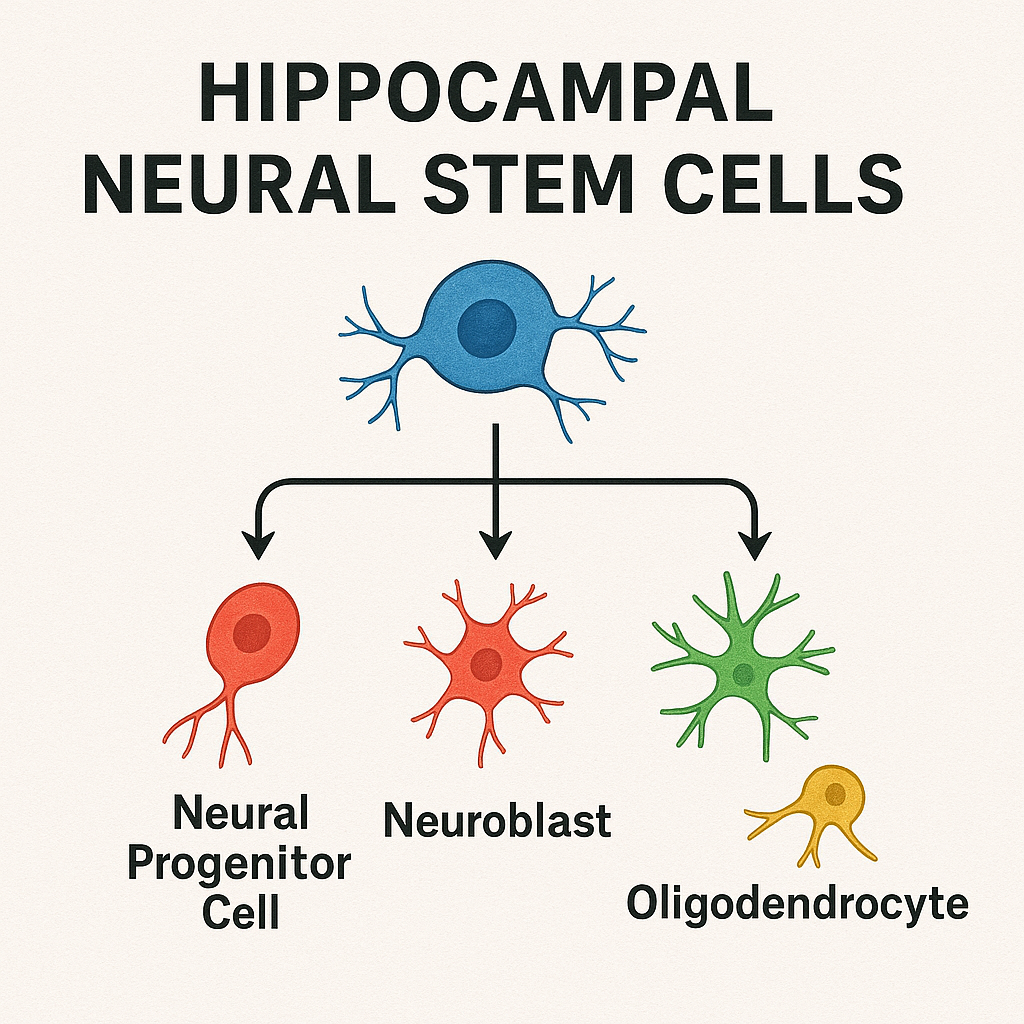
Hippocampal NSCs differentiate into:
-
Neurons (primarily excitatory granule neurons)
-
Astrocytes
-
Oligodendrocytes
Research at NIH Stem Cell Unit (stemcells.nih.gov) confirms their multipotent nature through lineage tracing and clonal analyses.
Self-Renewal Capacity
Adult hNSCs undergo:
-
Symmetric division → expands stem cell pool
-
Asymmetric division → generates differentiated progeny
Regulation of self-renewal is influenced by Notch, Wnt, and Sonic hedgehog (Shh) pathways (sources from Stanford Neurosciences Institute, neuroscience.stanford.edu).
Transcriptomic Characterization
Single-cell RNA sequencing (scRNA-seq), conducted in research centers such as Broad Institute (MIT/Harvard) (broadinstitute.org), reveals expression signatures of:
-
Nestin
-
Sox2
-
GFAP
-
Prominin-1 (CD133)
-
BLBP
-
DCX (in early neuroblasts)
-
Prox1 (DG neurons)
Molecular Signaling Pathways Governing hNSCs
Adult hippocampal NSCs are tightly regulated by interconnected pathways:
Wnt/β-Catenin Pathway
Wnt signaling from local astrocytes and hilar interneurons promotes:
-
NSC proliferation
-
Neuronal fate commitment
Wnt mechanisms are documented at UC San Diego Neuroscience (ucsd.edu).
Notch Signaling
Maintains stem cell quiescence via:
-
Hes1, Hes5 gene activation
-
Inhibition of proneural factors
Supported by data from NIH NCBI Bookshelf (ncbi.nlm.nih.gov/books).
Sonic Hedgehog (Shh) Pathway
Secreted by:
-
Mossy cells
-
Ventral hippocampal neurons
Shh enhances NSC proliferation, explained in Oxford Neuroscience (ox.ac.uk).
BMP and TGF-β Pathways
Regulate:
-
NSC quiescence
-
Differentiation vs. proliferation balance
Growth Factors
Key regulators include:
-
BDNF
-
FGF2
-
VEGF
-
IGF-1
Resources from National Institute on Aging (NIA) (nia.nih.gov) highlight age-related decline of growth factor activity.
Developmental Origins of Hippocampal NSCs
Embryonic Origin
Neural stem cells originate from dorsal neural tube progenitors during embryogenesis (sources from University of Michigan Neuroscience, umich.edu).
Postnatal Persistence
By late gestation, progenitors migrate to the dentate gyrus and establish the long-lived adult SGZ neurogenic pool.
Stem Cell Maintenance
Adult maintenance is influenced by:
-
Epigenetic plasticity
-
Chromatin remodeling (HDACs, DNMTs)
-
MicroRNAs (miR-9, miR-124)
-
Transcription factors (Sox2, Tlx, NeuroD1)
Adult Neurogenesis: From Stem Cell to Mature Neuron
Phase 1: NSC Proliferation
Occurs along SGZ border, promoted by Wnt and BDNF.
Phase 2: Progenitor Amplification
Type-2a and Type-2b progenitors expand population.
Phase 3: Neuroblast Migration
Newly generated neuroblasts migrate short distances into the granule cell layer, documented via imaging at NIH BRAIN Initiative (braininitiative.nih.gov).
Phase 4: Differentiation & Synaptic Integration
Immature neurons undergo:
-
Dendritic extension
-
Axonal targeting into CA3
-
Synaptic incorporation
Phase 5: Functional Maturation
New granule neurons contribute to:
-
Pattern separation
-
Spatial navigation
-
Memory encoding
Extensively studied in cognitive neuroscience programs at University College London (UCL) (ucl.ac.uk).
Regulatory Influences on hNSCs
Environmental Factors
Factors known to enhance neurogenesis:
-
Physical exercise
-
Enriched environments
-
Cognitive stimulation
Referenced in studies supported by National Institute of Mental Health (NIMH) (nimh.nih.gov).
Aging
Aging reduces:
-
NSC pool size
-
Proliferative capacity
-
Synaptic integration efficiency
Stress & Glucocorticoids
Chronic stress suppresses neurogenesis via:
-
Elevated cortisol
-
Suppressed BDNF
Information available from National Library of Medicine (nlm.nih.gov).
Inflammation
Activated microglia release cytokines that negatively affect neurogenesis.
Hippocampal NSCs in Neurological Diseases
Alzheimer’s Disease
Reduced neurogenesis is linked to cognitive decline, supported by data from NIA Alzheimer’s Research Centers (nia.nih.gov).
Depression & Anxiety
Antidepressants such as SSRIs increase hippocampal neurogenesis (documented by NIMH).
Epilepsy
Seizure activity causes aberrant neurogenesis, including:
-
Mispositioned granule neurons
-
Abnormal mossy fiber sprouting
Schizophrenia & Bipolar Disorder
Altered hippocampal neurogenesis may contribute to cognitive symptoms.
Traumatic Brain Injury (TBI)
NSCs are activated following injury; documented by NIH TBI programs.
Isolation, Culture, and Characterization of hNSCs
Isolation Techniques
Common isolation pipelines include:
-
Enzymatic dissociation
-
Microdissection of dentate gyrus
-
FACS based on GFP, Prominin-1, or Nestin reporters
Culture Conditions
Two main methods:
Neurosphere Culture
-
Growth in FGF2 + EGF
-
Free-floating spheres
Adherent Monolayer Culture
-
Laminin or poly-D-lysine coated plates
-
Controlled morphology and differentiation
Characterization Markers
Immunostaining for:
-
Nestin
-
Sox2
-
GFAP
-
DCX (neuroblasts)
-
NeuN (mature neurons)
Protocols available from ATCC and academic labs at UCLA Neuroscience (ucla.edu).
Therapeutic Applications of Hippocampal NSCs
Regenerative Medicine
Potential treatments for:
-
Alzheimer’s disease
-
Parkinson’s disease
-
Stroke
-
TBI
-
Major depressive disorder
Drug Discovery & Neurotoxicity Screening
hNSCs serve as in vitro systems for:
-
Neuroprotective drug screening
-
Glutamate toxicity models
-
Mitochondrial dysfunction assays
Gene Therapy
Vector-based delivery systems (AAV, LV) target NSCs for:
-
Gene repair
-
Neurotrophic factor expression
-
Disease modeling
Future Directions in Hippocampal NSC Research
CRISPR Functional Genomics
Editing key regulators:
-
Notch pathway components
-
Wnt modulators
-
Epigenetic regulators
Single-Cell Multiomics
Integration of:
-
scRNA-seq
-
scATAC-seq
-
Spatial transcriptomics
3D Hippocampal Organoids
Derived from pluripotent stem cells, used for:
-
Modeling hippocampal diseases
-
Testing neurogenesis-promoting drugs
Research published by leading institutions like Harvard Stem Cell Institute.
Conclusion
Hippocampal neural stem cells are among the most important cellular populations for adult brain regeneration, memory formation, and plasticity. Their unique capacity for self-renewal and controlled differentiation makes them essential for both basic neuroscience and clinical applications. Extensive research from leading .edu universities and .gov biomedical institutions continues to expand our understanding of the molecular, cellular, and translational relevance of hippocampal NSCs. As technologies such as CRISPR, single-cell sequencing, and 3D organoids evolve, the study of hippocampal NSCs will remain at the forefront of neuroscience, aging research, and brain repair biology.