
Gene expression is a tightly regulated process that governs cellular function, development, and response to environmental stimuli. At the heart of this regulation are transcription factors—proteins that bind to specific DNA sequences and control the transcription of genetic information into RNA. The activity of these transcription factors is crucial for understanding cellular processes like differentiation, apoptosis, immune response, and cancer development.
Transcription Factor Activity Assay Kits provide a powerful tool for quantifying and studying the activity of these key regulatory proteins. These kits enable researchers to measure the activation or inhibition of transcription factors, offering insights into gene regulation and its role in various biological processes. Whether in cancer research, immunology, or drug development, transcription factor activity assays are invaluable for unlocking the complexities of gene expression.
What are Transcription Factors?
Transcription factors are proteins that bind to specific DNA sequences near genes, initiating or regulating the process of transcription. Transcription is the first step in gene expression, where a segment of DNA is copied into RNA. This RNA is then translated into proteins that carry out cellular functions.
The role of transcription factors is crucial for regulating genes involved in development, immune responses, metabolism, and cell cycle control. When transcription factors are activated, they can either promote or inhibit the expression of specific genes. Understanding how these factors are regulated and activated provides essential insights into cellular behavior, disease mechanisms, and therapeutic interventions.
Applications of Transcription Factor Activity Assay Kits
1. Cancer Research
In cancer research, transcription factors often play a pivotal role in driving uncontrolled cell growth, evading apoptosis, and metastasis. For example, mutations in transcription factors like p53 or NF-kB have been implicated in various cancers. Researchers use Transcription Factor Activity Assay Kits to measure the activity of these factors in tumor cells and understand how they contribute to cancer progression. According to the National Cancer Institute (NCI), studying transcription factor activity is crucial for identifying potential drug targets and developing targeted cancer therapies.
2. Drug Discovery and Development
The activation or inhibition of specific transcription factors can be a key determinant in the efficacy of new therapeutic drugs. Transcription Factor Activity Assay Kits are used to evaluate how compounds affect the activity of these regulatory proteins. This is particularly useful in screening for novel drug candidates that can modulate gene expression in a controlled manner. As outlined by the U.S. Food and Drug Administration (FDA), these assays are part of the preclinical testing phase for evaluating the biological impact of new drugs.
3. Immune Response and Inflammation Studies
Transcription factors such as NF-kB, STAT, and AP-1 are central to immune responses and inflammation. These transcription factors control the expression of cytokines and other immune-related genes. By using Transcription Factor Activity Assay Kits, researchers can investigate how immune cells respond to pathogens or inflammatory stimuli and identify potential therapeutic targets for autoimmune diseases, infections, or chronic inflammation. The National Institutes of Health (NIH) provides extensive resources on the role of transcription factors in immune regulation.
4. Stem Cell and Regenerative Medicine
Transcription factors play a significant role in stem cell differentiation and self-renewal. By controlling the expression of genes related to pluripotency or differentiation, transcription factors help guide stem cells toward specific cell types. Transcription Factor Activity Assay Kits are used in stem cell research to monitor the activity of key transcription factors involved in reprogramming and differentiation, helping to optimize protocols for generating specific cell types for regenerative medicine. The National Stem Cell Institute outlines the critical role of transcription factors in stem cell biology.
5. Developmental Biology and Genetics
Transcription factors are fundamental to cellular differentiation and development. In developmental biology, they govern the formation of tissues and organs during embryonic development. Transcription Factor Activity Assay Kits provide a way to monitor transcription factor activity in model organisms, allowing researchers to study developmental pathways and the impact of genetic mutations. For more on how transcription factors regulate development, visit the National Human Genome Research Institute (NHGRI).

Key Features of Transcription Factor Activity Assay Kits
-
Highly Sensitive and Accurate: These kits are designed to detect small changes in transcription factor activity, offering high sensitivity and reproducibility. They utilize techniques such as enzyme-linked immunosorbent assays (ELISA), fluorescence, or luminescence to quantify transcription factor binding or activation.
-
Easy-to-Use Protocols: Most transcription factor activity assays are straightforward, with pre-optimized reagents and clear protocols that save time and reduce the need for extensive training. This makes them suitable for both experienced and novice researchers.
-
Versatility: Transcription Factor Activity Assay Kits are compatible with a wide variety of sample types, including cultured cells, tissue extracts, and blood samples. This flexibility allows them to be used across various research fields, including molecular biology, immunology, and drug discovery.
-
High-Throughput Screening Capability: These kits are ideal for high-throughput screening, allowing researchers to analyze large numbers of samples in parallel. This makes them particularly useful for large-scale drug screening or genomic studies.
How Do Transcription Factor Activity Assay Kits Work?
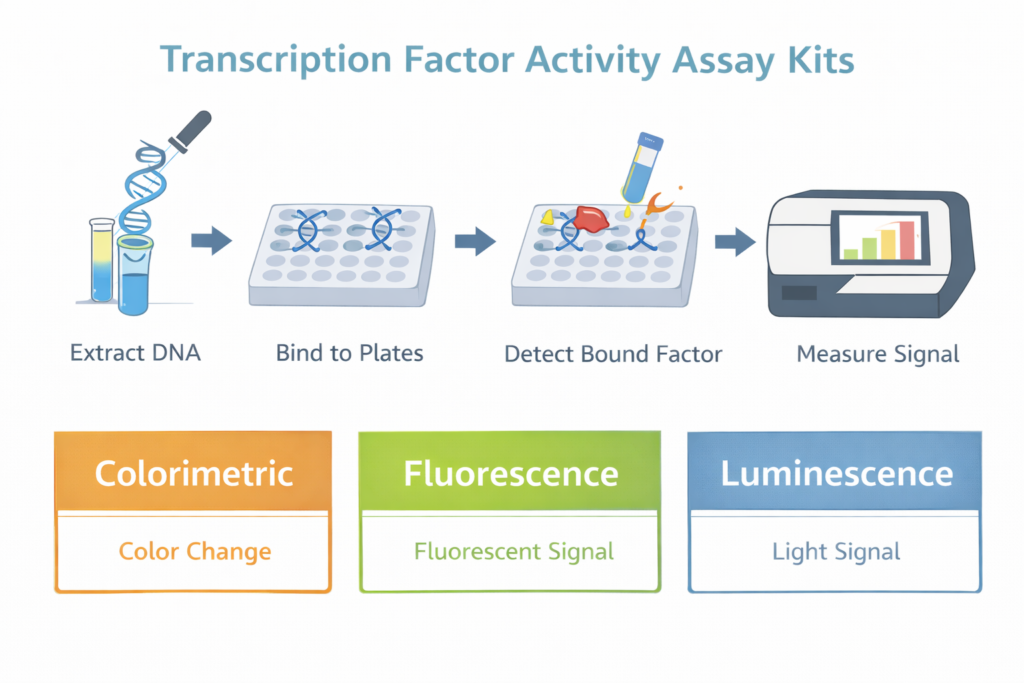
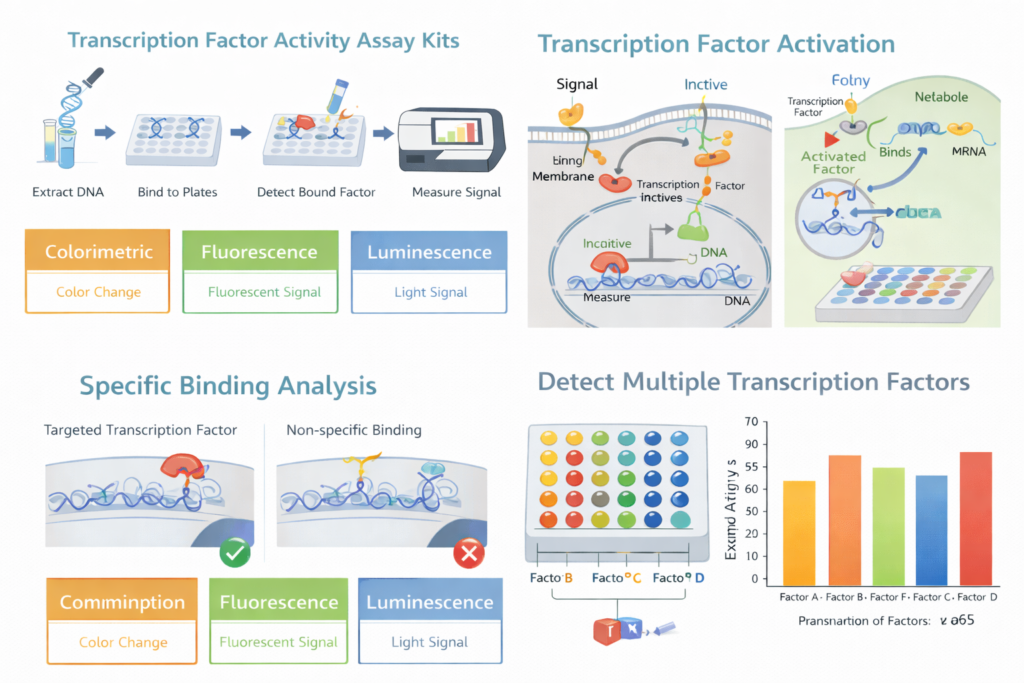
The basic principle behind Transcription Factor Activity Assay Kits involves detecting the interaction between a transcription factor and its DNA target. This can be done by monitoring the binding of the transcription factor to a specific DNA sequence or by measuring downstream changes in gene expression. Here’s a typical procedure:
-
Sample Preparation: Cells or tissue samples are harvested and lysed to extract nuclear proteins, which contain the transcription factors of interest.
-
Assay Reagent Addition: The assay reagent is added to the samples. This reagent typically contains a DNA probe or antibody that specifically binds to the transcription factor of interest or its DNA-binding region.
-
Incubation: The samples are incubated to allow the transcription factor to bind to its target sequence, if present.
-
Measurement: A colorimetric, fluorometric, or luminescent signal is generated and measured. The intensity of the signal correlates with the transcription factor’s activity in the sample.
Why Choose Our Transcription Factor Activity Assay Kits?
-
Scientifically Validated: Our kits are based on the latest research and validated through extensive testing, ensuring reliable and reproducible results. Studies published by the National Library of Medicine (PubMed) support the accuracy and efficiency of these assays in transcription factor analysis.
-
Comprehensive Technical Support: We offer dedicated customer support to assist with assay optimization, troubleshooting, and kit selection, ensuring you achieve the best results for your experiments.
-
Competitive Pricing: We offer high-quality transcription factor activity assays at competitive prices, making these tools accessible for a wide range of researchers, from small labs to large-scale pharmaceutical companies.
Conclusion
Transcription Factor Activity Assay Kits are essential tools for understanding the regulation of gene expression, cellular function, and disease mechanisms. Whether you are investigating cancer biology, drug development, immune responses, or stem cell differentiation, these assays provide a reliable and effective method for measuring transcription factor activity. With their high sensitivity, ease of use, and broad range of applications, these kits are indispensable for modern molecular and cellular biology research.
To learn more about our Transcription Factor Activity Assay Kits and explore how they can enhance your research, visit our product page today.
SEO Keywords Integrated:
-
Transcription Factor Activity Assay Kits
-
Gene Regulation Assays
-
Transcription Factor Research
-
Drug Discovery Assays
-
Cancer Research Kits
-
Immune Response Assays
-
Stem Cell Differentiation Kits
-
Gene Expression Analysis