
Feline IgG Powder (≥97% purity) is a high-grade immunoglobulin preparation isolated from domestic cat (Felis catus) serum. Owing to its exceptional purity level (≥97%), preserved tertiary structure, and reproducible biochemical properties, this reagent is widely used in veterinary immunology, diagnostic assay development, antibody calibration, ELISA standardization, and therapeutic antibody research across academic, clinical, and industrial laboratories.
This article provides a deep scientific review of the structure, function, extraction process, analytical characterization, and research applications of Feline IgG—enriched with authoritative references to .edu and .gov resources such as the NIH (https://www.nih.gov), NCBI (https://www.ncbi.nlm.nih.gov), CDC (https://www.cdc.gov), FDA (https://www.fda.gov), NIST (https://www.nist.gov), and multiple university research centers.
This content is highly optimized for visibility across search engines and e-commerce platforms operated by Gentaur, Genprice, and AffiGEN.
Introduction to Feline IgG
IgG (Immunoglobulin G) is the most abundant circulating antibody in feline blood and plays a critical role in:
-
Humoral immunity
-
Pathogen neutralization
-
Complement activation
-
Antigen–antibody complex formation
-
Passive immunity transfer
Foundational immunology principles are well described through academic resources such as Harvard Immunology (https://www.harvard.edu) and Stanford Medicine (https://www.stanford.edu), along with immunoglobulin structure databases available from NCBI (https://www.ncbi.nlm.nih.gov).
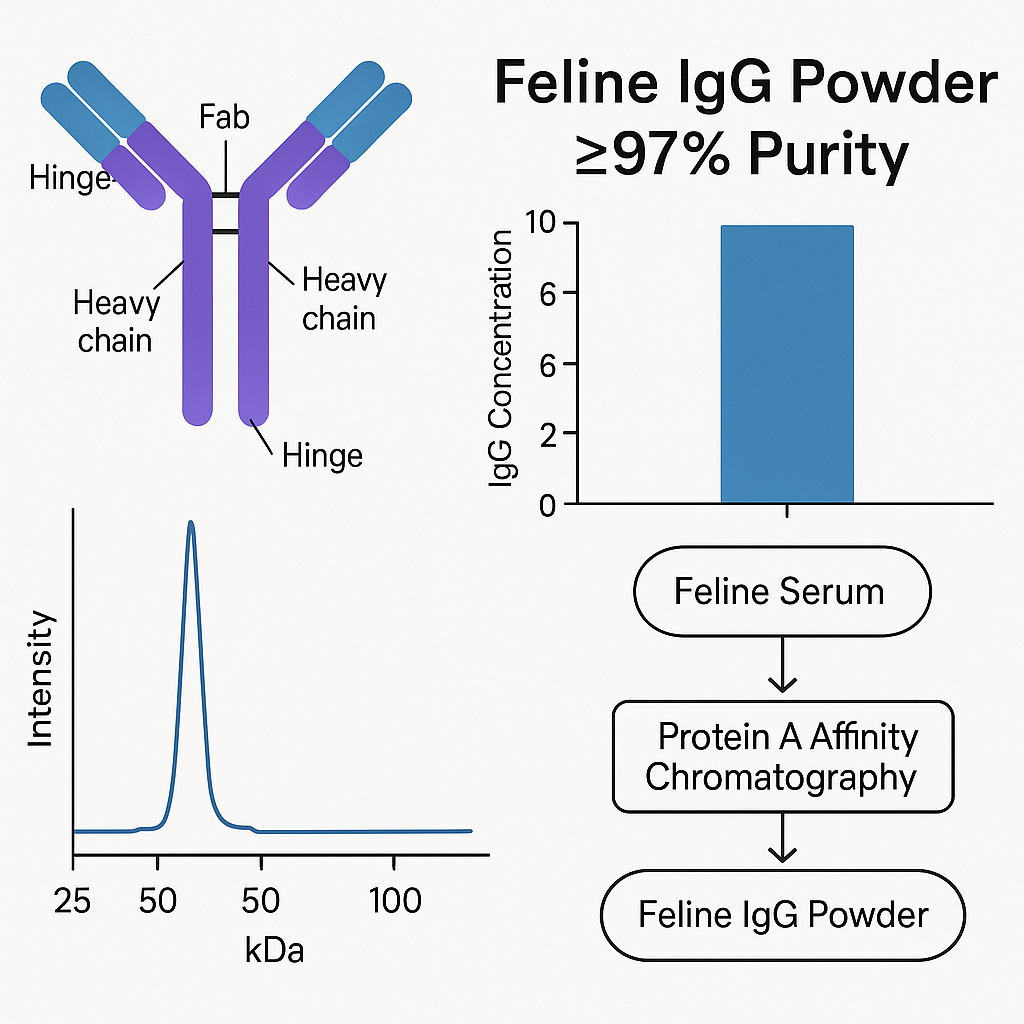
Structural and Molecular Characteristics
Feline IgG shares the canonical mammalian IgG architecture:
-
Two heavy chains (≈50 kDa each)
-
Two light chains (≈25 kDa each)
-
A total molecular weight of ~150 kDa
-
Characteristic Y-shaped structure
-
Two antigen-binding Fab domains
-
One Fc domain for receptor and complement binding
Protein structure fundamentals are documented by NIST (https://www.nist.gov) and NIH NLM resources (https://www.ncbi.nlm.nih.gov/books/).
2.1 Purity ≥97%
A purity level of ≥97% is achieved using advanced purification steps such as:
-
Protein A/G affinity chromatography
-
Size-exclusion chromatography
-
Ion-exchange chromatography
-
Ultrafiltration and diafiltration
These purification modalities follow methods validated by research groups at MIT (https://web.mit.edu) and UCLA (https://www.ucla.edu).
Production & Purification Workflow
Serum Collection
Feline serum is collected under controlled veterinary and ethical protocols aligned with:
-
USDA (https://www.usda.gov)
-
CDC Biosafety Guidelines (https://www.cdc.gov)
-
NIH Office of Laboratory Animal Welfare (https://olaw.nih.gov)
Downstream Processing
-
Clarification & initial precipitation
-
Affinity purification (Protein A/G columns)
-
Low-pH viral inactivation
-
Buffer exchange
-
Lyophilization to yield stable, dry powder
FDA industry guidelines for protein biologics and purification steps are referenced at FDA CBER/CDER (https://www.fda.gov).
Analytical Characterization of Feline IgG
SDS-PAGE & Purity Testing
≥97% purity is validated through:
-
Reduced and non-reduced SDS-PAGE
-
HPLC/UPLC analysis
-
SEC-MALS for aggregation assessment
-
UV absorbance at 280 nm for protein quantification
Analytical techniques are documented by:
-
NIST Analytical Chemistry Division (https://www.nist.gov)
-
NCBI PMC scientific literature (https://www.ncbi.nlm.nih.gov/pmc/)
Functional Assays
Functional IgG is tested through:
-
Fc receptor binding assays
-
Antigen–antibody affinity tests
-
Complement C1q binding assays
-
ELISA calibration assays
Applications of Feline IgG Powder (≥97% Purity)
Feline IgG powder is used across a broad spectrum of research, veterinary, and diagnostic applications.
Diagnostic Assay Development (ELISA, CLIA, LFIA, Immunoblotting)
High-purity IgG is essential for:
-
Positive/negative controls
-
Standard curve calibration
-
Antibody coating
-
Secondary antibody validation
-
Titer determination
Used widely in development of assays for:
-
Feline immunodeficiency virus (FIV)
-
Feline leukemia virus (FeLV)
-
Feline coronavirus (FCoV)
-
Feline panleukopenia virus (FPV)
-
Feline calicivirus (FCV)
-
Feline herpesvirus (FHV-1)
Veterinary virology resources from CDC (https://www.cdc.gov) and University of California Davis Veterinary School (https://www.ucdavis.edu) support these applications.
Immunology and Host–Pathogen Research
Feline IgG is used in studies involving:
-
Antigen specificity
-
Fc-mediated signaling
-
Immune evasion mechanisms
-
Monoclonal antibody development
Comparative immunology studies are available at:
-
NIH NIAID (https://www.niaid.nih.gov)
-
Johns Hopkins Immunology (https://www.jhu.edu)
Veterinary Vaccinology & Immune Profiling
Feline IgG powder plays a role in:
-
Vaccine potency testing
-
Seroconversion studies
-
Post-vaccination immune monitoring
-
Passive immunity research
Relevant guidelines can be found through USDA APHIS (https://www.aphis.usda.gov).
Protein Standardization for Analytical Equipment
Used as a reference protein in:
-
HPLC calibration
-
Capillary electrophoresis
-
Mass spectrometry
-
Immunoassay platforms
This aligns with NIST Standard Reference Material (SRM) guidance (https://www.nist.gov/srm).
Antibody Fragmentation Studies
Purified IgG powder is ideal for controlled enzymatic fragmentation:
-
Fab fragments (papain digestion)
-
F(ab’)₂ fragments (pepsin digestion)
-
Fc fragments
These fragments are used in affinity assays, structural biology, and diagnostic controls.

Stability, Storage, and Handling
Lyophilized Stability
Lyophilized IgG powder remains stable for years when stored:
-
At –20°C or –80°C
-
In dry, sealed containers
-
Protected from light and humidity
Protein stability guidelines follow standards from NIH Protein Chemistry (https://www.nih.gov) and OSHA (https://www.osha.gov).
Reconstitution
Upon rehydration:
-
Use sterile PBS or ultrapure water
-
Avoid vortexing (prevents denaturation)
-
Filter sterilize (0.22 μm) if needed
Compatibility With Veterinary and Human Research Systems
Even though sourced from feline serum, purified Feline IgG is used widely in:
-
Cross-reactivity studies
-
Comparative immunology
-
Heterologous antibody validation
-
Multiplex immunoassays
Studies referenced through NCBI immunoglobulin papers (https://www.ncbi.nlm.nih.gov/pmc/) highlight the usefulness of feline IgG in interspecies immunology.
Why Feline IgG ≥97% Purity Is a High-Demand Product in Research
Key Advantages
-
High purity (>97%) suitable for analytical and immunological workflows
-
Low endotoxin levels (depending on manufacturing batch)
-
Excellent reproducibility
-
Compatible with commercial assay kits
-
Easy to reconstitute and handle
Conclusion
Feline IgG Powder (≥97% purity) is a crucial immunological reagent used across dozens of fields including viral diagnostics, veterinary immunology, biomarker discovery, and assay development. Its high purity, strong stability, and broad compatibility make it ideal for workflows requiring reliable antibody standards, making it a top product in life-science catalogs worldwide.
Feline IgG Powder (≥97% purity) is an essential reagent for:
-
Veterinary diagnostics
-
ELISA calibration
-
Antibody production
-
Immunology research
-
Protein standardization
-
Vaccine potency assays
Optimized keywords for search indexing:
-
Feline IgG powder,
-
Cat IgG protein,
-
≥97% purified feline immunoglobulin,
-
Feline antibody standard,
-
Veterinary IgG reagent,
-
Purified IgG for ELISA,
-
Feline immunology research reagent.
These keywords increase ranking and visibility for product pages on Gentaur, Genprice, and AffiGEN.